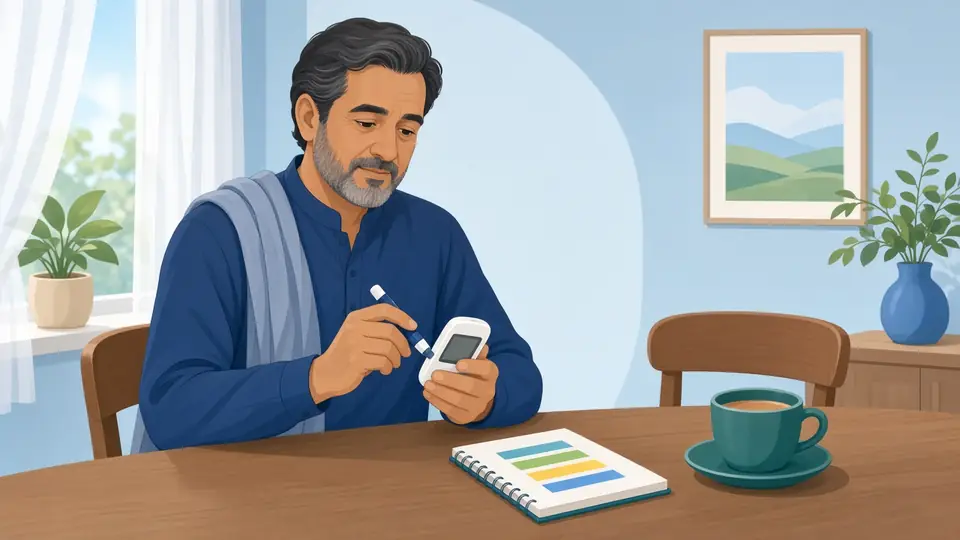
Sugar ke mareez roza kaise rakhen: Ramzan 2027 plan with the IDF-DAR risk score
Diabetes mein roza rakhna safe hai ya nahi? Score yourself on the IDF-DAR risk table, see when you must break the fast (below 70 or above 300 mg/dL), how doctors adjust metformin, gliclazide and insulin for sehri and iftar, and a desi sehri-iftar plate for Ramzan 2027.
Key points
- Ramzan 2027 is expected to start on 8 or 9 February (moon sighting). Fasts in Pakistan will be roughly 12 to 13½ hours, much shorter than summer Ramzans.
- Doctors use the IDF-DAR risk score. 0–3 = low risk (usually able to fast), 3.5–6 = moderate (advised not to fast), above 6 = high (should not fast).
- Break the fast immediately if sugar is below 70 mg/dL or above 300 mg/dL, or you feel shaky, confused, faint or very unwell.
- A finger-prick sugar check does not break the fast, according to the international Ramadan diabetes guidelines.
- Medicine timings and doses usually need changing. Get this done at a pre-Ramzan visit 6–8 weeks before, not on the first sehri.
Every year, around Shaban, the same question comes up in Pakistani homes: "Abbu ko sugar hai, roza rakhen ya na rakhen?" The answer is not the same for everyone. Some people with diabetes fast all 30 days without trouble. Others end up in emergency with a sugar of 40 or 450.
The difference is usually preparation. Diabetes is very common here: the second National Diabetes Survey of Pakistan found it in 26.3% of adults, and 7.1% didn't know they had it. In a 13-country study of more than 12,000 people with diabetes, about 79% of those with type 2 fasted for at least 15 days of Ramadan, and severe lows were more frequent than in other months, especially in people who changed their medicine doses or activity on their own. This guide is built around the 2021 Diabetes and Ramadan (IDF-DAR) Practical Guidelines, the international guidance doctors use, written with Pakistani diabetologists among its authors. It turns that guidance into something you can use at home: a risk score you can work out, clear "break the fast" numbers, and a sehri and iftar plate made from food we actually eat.
Ramzan 1448 is expected to begin on Monday 8 or Tuesday 9 February 2027, depending on the Ruet-e-Hilal Committee's moon sighting. That gives you about ten weeks from now. Use them.
Your 10-week countdown
| When | What to do |
|---|---|
| Now to mid-December | Get an HbA1c, fasting sugar, kidney test (creatinine/eGFR) and urine albumin if not done in the last 3 months. HbA1c costs roughly Rs 1,500 to 2,400 at major private labs (prices listed online in November 2026). |
| Late December to early January | Pre-Ramzan visit with your doctor. Take your sugar diary, all medicine strips and this risk table. Ask: "Kya main roza rakh sakta hoon? Meri dawaiyon ka timing kya hoga?" |
| January | If your doctor starts a new medicine, it should begin 2–4 weeks before Ramzan so it settles. Practise checking sugar at home if you don't already. |
| First week of February | Stock up on glucometer strips, a small juice pack or glucose tablets for lows, and plan sehri foods. Tell family the "break the fast" numbers. |
| First 3 roza | Check sugar more often than you think you need to. Most problems show up in the first few days. |
Step 1: work out your risk score
This is the scoring table from the IDF-DAR guidelines (simplified wording). Add up one score from each row that applies. Do this with your doctor: some items, like kidney function, need test results, and your doctor may weigh things differently.
| Risk factor | Score |
|---|---|
| Type 1 diabetes | 1 |
| Had diabetes for 10 years or more | 1 |
| Can't feel low sugar coming (hypo unawareness) | 6.5 |
| Severe low sugar recently (needed someone's help) | 5.5 |
| Low sugar several times a week | 3.5 |
| Low sugar less than once a week | 1 |
| HbA1c above 9% | 2 |
| HbA1c 7.5–9% | 1 |
| Multiple daily mixed insulin injections | 3 |
| Basal-bolus insulin or insulin pump | 2.5 |
| Once-daily mixed insulin | 2 |
| Basal (long-acting) insulin only | 1.5 |
| Glibenclamide | 1 |
| Gliclazide, gliclazide MR, glimepiride or repaglinide | 0.5 |
| Sugar checks advised but not done / done irregularly | 2 / 1 |
| DKA or hyperosmolar coma in last 3 / 6 / 12 months | 3 / 2 / 1 |
| Unstable heart or blood-vessel disease / stable | 6.5 / 2 |
| Kidney function eGFR below 30 / 30–45 / 45–60 | 6.5 / 4 / 2 |
| Pregnant with sugar not at target / at target | 6.5 / 3.5 |
| Frail or memory problems / over 70 with no one at home | 6.5 / 3.5 |
| Heavy physical labour / moderate | 4 / 2 |
| Bad experience in a previous Ramzan | 1 |
| Fasting 16 hours or more | 1 |
What the total means:
- 0 to 3, low risk: you should be able to fast, with monitoring and medicine changes.
- 3.5 to 6, moderate risk: the guidelines advise not fasting. If you still choose to, it should be a decision made with your doctor, with extra checks and a firm plan to stop if problems start.
- Above 6, high risk: you should not fast.
Two Pakistani points worth knowing. First, fasts in February–March 2027 will be roughly 12 to 13½ hours in most cities, so the "16 hours or more" point won't apply. Second, "physical labour" matters here more than in many countries. A rickshaw driver, a labourer or a farmer working in the fields scores very differently from someone at a desk.
Islam already exempts people who are ill, and missed fasts can be made up later or, for people who will never be able to fast, compensated with fidya. The guidelines encourage doctors and religious scholars to work together on this. If your doctor says you shouldn't fast, talk to a scholar you trust as well. You are not being "less religious" by protecting your health.
Step 2: know when to break the fast
Write these on a paper and stick it on the fridge. The IDF-DAR guidelines say everyone should break their fast if:
| Situation | What to do |
|---|---|
| Sugar below 70 mg/dL | Break the fast now. Take a quick sugar: a small glass of fruit juice or 5 glucose tablets. Recheck in 10–20 minutes. |
| Sugar 70–90 mg/dL | Don't panic, but recheck within 1 hour. If it keeps falling, break the fast. |
| Sugar above 300 mg/dL | Break the fast, drink water, and contact your doctor. If you're vomiting, very drowsy or breathing fast, go to hospital. |
| Shaking, sweating, palpitations, confusion, headache | Check sugar right away. If you can't check, treat it as low sugar and break the fast. |
| Extreme thirst, vomiting, stomach pain, feeling faint | Break the fast and get medical advice. This can be dehydration or high sugar. |
A common and dangerous belief in our families is "thori der aur, iftar qareeb hai." With a sugar below 70, waiting can mean fainting, a fall or a fit. Breaking the fast in this situation is the correct, permitted thing to do.
And to settle a frequent worry: checking sugar with a finger prick does not break your roza. The guidelines specifically call this a misconception and say people should keep checking.
Step 3: when to check your sugar
The guidelines suggest a "7-point" pattern for people at higher risk or on insulin:
- At sehri
- Morning
- Midday
- Mid-afternoon (this is when lows often show up)
- Just before iftar
- 2 hours after iftar (this catches the post-iftar spike)
- Any time you feel unwell
If you're low risk and on metformin alone, once or twice a day may be enough. Ask your doctor. Not sure what your numbers mean? Our sugar level chart explains normal fasting and after-meal values. Everyone should check at least once after iftar, because heavy iftars are where sugar shoots up.
Step 4: medicines (for discussion with your doctor)
Do not change doses on your own. The table below shows what the 2021 guidelines generally recommend so you know what to ask. Your doctor may change it based on your sugar and kidneys.
| Medicine | Usual Ramzan change in the guidelines |
|---|---|
| Metformin once daily | Take at iftar. Dose usually unchanged. |
| Metformin twice daily | Take at iftar and sehri. |
| Metformin three times daily | Morning dose at sehri; afternoon dose combined with the iftar dose. |
| Gliclazide / glimepiride once daily | Take at iftar; dose may be reduced if sugar is well controlled. |
| Gliclazide twice daily | Iftar dose same; sehri dose reduced if sugar is well controlled. |
| Glibenclamide | Higher risk of lows. The guidelines advise switching to a newer option before Ramzan. |
| SGLT2 inhibitors (the "-gliflozin" medicines) | Take at iftar, drink plenty of fluid after iftar. Best started at least 2–4 weeks before Ramzan. |
| Long-acting insulin once daily | Usually reduced by 15–30% and taken at iftar. |
| Mixed insulin twice daily | Normal dose at iftar; sehri dose reduced by 20–50%. |
After the first few days, your doctor may adjust insulin by a few units every few days, based on your sehri and pre-iftar readings. Keep a simple diary: date, sehri reading, afternoon reading, pre-iftar, post-iftar.
Step 5: a desi sehri and iftar that won't spike you
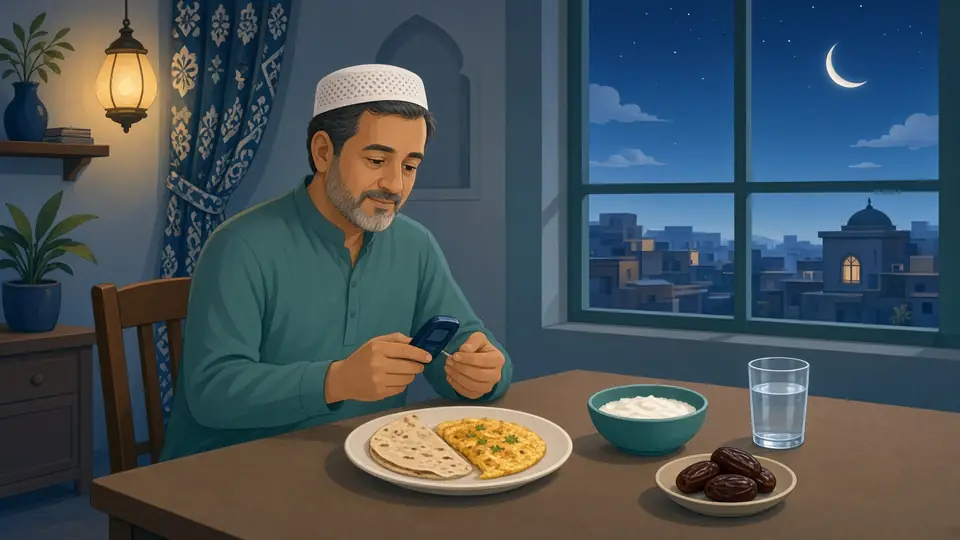
The guidelines say: divide calories between sehri and iftar, choose slow carbohydrates, limit ghee and fried foods, avoid sugary drinks and desserts, and eat sehri as late as possible.
Sehri
| Instead of | Try |
|---|---|
| Ghee paratha, or two | 1 chapati (or a thin, lightly oiled paratha once in a while) |
| Pheni or khajla in sweet milk | Dalia or oats in milk without sugar, or 2 eggs |
| Sweet lassi | Plain dahi or salted lassi |
| Only chai | Chai is fine, but also 2–3 glasses of water |
| Nothing (skipping sehri) | Never skip sehri if you have diabetes |
Add protein (eggs, daal, chana, dahi) because it keeps sugar steadier through the day.
Iftar
- Open with water and 1–3 small khajoor. Not a plateful.
- Then pray Maghrib. This natural pause stops the "eat everything at once" rush.
- Take a small portion of pakoray or a samosa if you must, not both, and not every day.
- Fruit chaat without added sugar and with a pinch of chaat masala is better than sugary dahi baray or jalebi.
- Skip the rose and fruit sharbat syrups and cold drinks. Lemon water without sugar, or plain water, instead.
- Main meal later: half plate salad or sabzi, a quarter daal, chicken or fish, a quarter chapati or rice. Our diabetes diet plan with desi food has more meal ideas.
Between iftar and sehri
Drink water steadily from iftar to sehri, a glass or two at a time, instead of a jug at once. Limit tea and cola, which make you pass more urine. A handful of nuts or a fruit is a better late snack than biscuits or mithai.
Taraweeh and exercise
Taraweeh counts as exercise. A study cited in the guidelines found people with type 2 diabetes who prayed Taraweeh had better HbA1c and weight results. Keep your usual walking, but do it after iftar, not in the last hours before sunset when sugar is lowest. Avoid heavy workouts while fasting.
Eid and after
Eid is when many people undo a good month: sheer khurma, mithai and three dawats a day. Go back to your normal medicine timings after Ramzan (your doctor will tell you how) and check your HbA1c again about 2–3 months later.
See a doctor promptly if
- You take insulin, glibenclamide, gliclazide or glimepiride. These are the medicines most likely to cause low sugar while fasting.
- You've had severe low sugar, DKA or a hospital stay for sugar in the last year, or you can't feel when your sugar is low.
- You have kidney disease, heart disease, a foot ulcer, or you are pregnant.
- During a fast you get vomiting, chest pain, breathlessness, confusion or fainting. Break the fast and get help; call 1122 in an emergency.
Frequently asked questions
Does checking blood sugar break the fast?
No. The international Diabetes and Ramadan guidelines state clearly that a finger-prick sugar test does not break the fast, and that people with diabetes should keep checking during the day.
Can type 1 diabetics fast in Ramzan?
Type 1 diabetes scores higher on the risk table, and many people with type 1 are in the moderate or high-risk group. Some with good control, an insulin pump or modern insulins and close monitoring do fast under specialist care. It's a decision for you and your diabetes specialist, not one to make alone.
Does an insulin injection break the roza?
This is a religious question, and Pakistani scholars have issued rulings on it. Ask a mufti you trust. Medically, if you take insulin and plan to fast, your doses and timings must be changed, and you need to check sugar more often.
My sugar is 250 in the afternoon. Should I break the fast?
The guidelines set the limit at above 300 mg/dL. At 250, drink plenty of water after iftar, recheck, and tell your doctor, because it may mean your medicines need adjusting. If you feel unwell, very thirsty or start vomiting, break the fast regardless of the number.
Can I fast if I'm pregnant and have diabetes?
Pregnant women have the right not to fast whether or not they have diabetes. Pregnancy with diabetes scores high on the risk table. Speak to your gynaecologist well before Ramzan.
What if I accidentally miss sehri?
If you take insulin or gliclazide/glimepiride, fasting without sehri raises your risk of a low. Talk to your doctor now about what to do on a missed-sehri day; many will advise not fasting that day.
Sources
- Hassanein M, et al. Diabetes and Ramadan: Practical guidelines 2021. Diabetes Research and Clinical Practice, 2022.
- International Diabetes Federation and DAR International Alliance. Diabetes and Ramadan: Practical Guidelines (full document, PDF).
- Salti I, et al. A population-based study of diabetes and its characteristics during the fasting month of Ramadan in 13 countries (EPIDIAR). Diabetes Care, 2004.
- Basit A, et al. Prevalence of diabetes, pre-diabetes and associated risk factors: second National Diabetes Survey of Pakistan (NDSP), 2016–2017. BMJ Open, 2018.
- Diabetes UK. Diabetes and Ramadan.
- NHS. Low blood sugar (hypoglycaemia).
- NHS. Diabetic ketoacidosis.
Sources were checked on 26 November 2026. Found an error? Tell us and we will correct it.
Medical disclaimer: This article is general information, not a diagnosis or treatment plan. Please talk to a qualified doctor about your own situation. Read our full disclaimer.
Sugar aur BP par weekly tips
One short email a week: desi diet, readings and small habits that help. Free, no spam.
We only use your email to send this newsletter and never share it. Unsubscribe anytime, every email has a one-click link. Privacy policy
Shukriya! You're subscribed. Pehli email jald aayegi.
Something went wrong. Please check your email address and try again.